Pubdate:2026-08-20
GSEPT202601. Multimodal Critical Reading Agent
Awardee(s):
Yang Lingyu, Guo Yutong, Zhang Zeming, Zhang Ruiran, Guo Runze, Liu Chuan, Xiang Qiurong, Li Xiaoming, Chen Zifan, Zhang Lizhen
Institution/Organization/Employe:
Yuanfudao
Keywords:
AI-reading, Inteligent Reading Companion Platform, Digital transformation of education
Executive Summary:
Yuanfudao Al Advanced Reading is an intelligent reading companion plalform developed for students from Grade 1 to Grade 6. Powered by multimodal Al technologies, it complies with the requirements of the New Curriculum Standard for whole-book reading and youth reading literacy cultivation. The platform builds a closed-loop intelligent reading teaching system and focuses on core teaching pain points of both teachers and students. It effectively solves the homogenization and superficiality of traditional reading instruction and addresses the difficulty of scaling. In primary school reading teaching, students generally suffer from poor concentration, superficial reading and insufficient in-depth critical thinking. Teachers face challenges such as lack of personalized guidance, scarcity of high-quality instructors and high teaching costs. Meanwhile, mainstream reading products in the narket lack complete teaching logic, real-time interaction and in-depth content. Supported by leading Al technologies and iterative data optimization, this project reconstructs traditional teaching modes and realizes human-computer collaborative personalized teaching. Stably launched and operated, the platform currently serves 300,000 primary school students with more than 200 high-quality reading courses. All core technical and teaching indicators rank among the industry's best. The project significantly improves students in-depth reading ability, reduces teachers teaching costs, and establishes a digital and inclusive model for reading education. It provides a mature implementation path for the digital transformation of primary school reading teaching and the large-scale popularization of high-quality educational resources, delivering outstanding educational value and industry demonstration significance.
Project Description:
1. Project Background
China's K12 reading education is undergoing a shift from fragmented knowledge accumulation to competency-based cultivation. The New Curriculum Standard lists whole-book reading as a core teaching module and clarifies the direction of digital intelligent reading education. Traditional fragmented reading modes can no longer meet current competency cultivation requirements. Existing market products have obvious defects: general Al tools lack teaching logic, gamified products are superficial, and recorded courses cannot support real-time interaction. The industry lacks classroom-adaptive and scalable personalized reading teaching solutions.
Frontline reading teaching faces prominent dual pain points. For students, unified teaching rhythms fail to adapt to individual differences, resulting in poor concentration, superficial reading and insufficient deep thinking. For teachers, limited staffing makes one-on-one guidance impossible. High-quality reading teachers are scarce and costly to cultivate, leading to uneven distribution of premium educational resources and difficulty in popularizing personalized teaching. Against these industrial and teaching challenges, Yuanfudao launched the Al Advanced Reading Project relying on its solid technical and educational research strengths.
2. Core Problems Solved
The project targets three key teaching difficulties. First, it adopts immersive intelligent interaction to improve students' poor reading concentration and weak autonomous reading persistence. Second, it applies Al hierarchical heuristic guidance to eliminate superficial reading problems and help students understand texts deeply and internalize knowledge. Third, it breaks the traditional "one-size-fits-all" teaching mode, leverages Al personalized teaching to make up for the shortage of high-quality teachers, and realizes low-cost, large-scale personalized reading instruction.
In addition, the project remedies common defects of mainstream reading products. It constructs a standardized classroom-oriented teaching system and solves industry problems including poor interaction, missing teaching logic and low content adaptability, providing a new scalable intelligent solution for primary school whole-book reading teaching.
GSEPT202602. 4D Metaverse Earthquake Simulation
Awardee(s):
I. Afsin Kariper, Esra Sahbaz
Institution/Organization/Employe:
Erciyes University, Faculty of Education
Keywords:
AI reading support; comprehension scaffolding; document intelligence; multilingual learning; equitable literacy
Executive Summary:
ReadAI / is an AI reading-intelligence assistant that helps learners understand complex text through document-aware explanations, vocabulary support, guided questions, and comprehension scaffolding. Many learners, especially students, adult learners, immigrant families, and underserved communities, have access to digital content but lack individualized reading support. ReadAI turns static reading material into an interactive learning process: learners can ask questions, inspect meaning, clarify unfamiliar language, and practiceunderstanding without depending on constant human tutoring. The project advances smart education by applying AI responsibly to improve comprehension, inclusion, and lifelong learning access.
Project Description:
ReadAI was inspired by a practical problem in education: learners often fail not because they lack motivation or content, but because difficult text remains inaccessible. A textbook chapter, school assignment, civic document, workplace manual, or English-language article can block learning when the reader cannot identify the main idea, decode vocabulary, or ask a knowledgeable tutor for help. Generic AI chatbots can summarize text, but summarization alone does not teach comprehension. ReadAI is designed as a reading-intelligence assistant. It helps learners slow down, ask better questions, compare an explanation with the original passage, build vocabulary, and generate practice prompts. The project is built around the idea that AI should scaffold learning rather than replace thinking. The specific issue addressed is unequal access to individualized reading support. Human tutoring, bilingual help, and patient explanation are limited in many homes, schools, libraries, and community programs. ReadAI aims to make this support more available through a software system that can assist learners across reading levels and contexts while preserving transparency, privacy awareness, and responsible AI use.
GSEPT202501. AI Digital Assistant Suite for Higher Education Transformation
Participant: Maxim Jean-Louis
Keywords:
AI Tutor Pro, Digital Assistants, Personalized Learning, Smart Education, Multilingual Access
Executive Summary:
Contact North | Contact Nord, a publicly funded education and technology support network based in the province of Ontario, Canada, developed and freely deployed the world’s first integrated suite of AI-powered personal digital assistants for higher education. This innovation includes AI Tutor Pro, AI Teaching Assistant Pro, AI Pathfinder Pro, and AI Trades Explorer Pro, tools designed to reduce faculty workload and support learners with personalized, multilingual, on-demand support. Developed by a small in-house team and grounded in public service values, these apps have generated over 2.3 million user interactions across nearly 300,000 users, exemplifying scalable, inclusive, and transformative digital learning innovation.
Project Description:
Contact North | Contact Nord is Ontario’s bilingual (English/French) technology support and distance learning network serving over 1,500 communities in Canada’s largest province. Its public mandate is to expand equitable access to post-secondary education through innovative technologies. In response to increasing pressure on faculty and students, it developed a suite of AI-powered assistants that addresses critical teaching and learning needs:
AI Tutor Pro: Provides multilingual, 24/7 personalized learning assistance for learners studying any subject, anywhere and at any level.
AI Teaching Assistant Pro: Supports faculty with feedback automation, instructional design support and content development.
- AI Pathfinder Pro: Recommends personalized academic and career pathways linked to local learning opportunities.
- AI Trades Explorer Pro: Helps learners navigate skilled trades opportunities.
The AI-support for smart learning projects is unique in its non-commercial design: tools are free to use, web-accessible, and require no special infrastructure. Built internally by a small team, these tools are accessible in English, French, Spanish, Arabic, Mandarin, and Portuguese. Their goal is not just innovation but transformation, delivering high-quality AI capabilities to students and educators across all contexts, especially rural and underserved communities.
GSEPT202502. ActivPanel 10 with ActivSuite
Participants:
Rachel Ashmore, Nedelka Phillips, Robert Cros
Keywords:
Interactive Teaching Solution
Executive Summary:
Promethean ActviPanel 10 Premium with Promethean ActivSuite™ is an integrated solution of hardware and software designed to enhance classroom engagement and improve learning outcomes whilst allowing teachers to use the operating systems native to their school or district both at and away from the ActivPanel. Comprised of tools like Explain Everything whiteboard, Promethean ActivSuite enables educators to deilver dynamic, interactive lessons with ease using annotation, polling, and multimedia integration. Designed for use with Promethean’s interactive displays and compatible with multiple platforms, it empowers teachers to deliver immersive, student-centered learning experiences. With Promethean ActivSuite, educators gain a powerful solution that transforms traditional teaching into interactive and impactful 21st-century education.
Project Description:
The project was inspired by research we conducted into problems teachers face when implementing new technology. Educators often juggle multiple tools and platforms which can disrupt learning and classroom flow. Our solution, Promethean ActivSuite, integrates lesson planning, delivery and student interaction into one ecosystem, reducing complexity and making adoption and useage less overwhelming and streamlined with the flow of the classroom. Intuitively designed, Promethean ActivSuite allows teachers to access their preferred panel apps from anywhere, anytime they need them. Strong online support materials on Learn Promethean to help with adoption and training.
K-12 teachers need help reducing their tech overload as well as help accessing content and resources when they need it and ActivPanel 10 Premium offers the solution. ActivPanel 10 Premium delivers familiarity by allowing teachers to use their operating system of choice where all their preferred resources are available. This choice of operating system is a unique benefit compared to other edtech solutions that rely on panels with built in operating systems and apps that require teachers to switch between content sources and different operating systems.
In addition, ActivPanel 10 Premium delivers industry leading specifications including best-in-class visual quality, low energy consumption, high quality sound with an 8 mic array and built-in soundbar, and accessories including a new ActivPen® 2 and All-in-one Remote (remote available in N.A. only) so that every student, no matter where they are, can equally engage in lessons.
Target users include post-secondary faculty, instructional designers, academic leaders, and learners, especially those in rural, remote, multilingual, or equity-seeking environments. The tools are used in Ontario, across Canada, and internationally. Contact North | Contact Nord engages users via direct outreach, institutional demos, global presentations, and partnerships. Because the tools are zero-cost, bilingual, and multilingual, they offer scalable value to institutions lacking internal AI infrastructure or budgets, enabling broader educational inclusion, aligned with the goals of smart education.
GSEPT202503. Huawei Smart Education Industry Solutions
Participants:
Li Junfeng, Zhang Chengtao, Chen Yuanbo, Chen Huijuan, Chen Keyu
Keywords:
AI+Education, Smart Classroom, Smart Campus, Research Data Management, Digital Training
Executive Summary:
Education is the foundation of a nation, and talent is the cornerstone of national development. As the digital economy continues to grow, It is expected to require 200 million ICT professionals in the worldwide by 2025. However, there will be a talent gap of 60 million. This highlights the key role that talent plays in the growth of digital economy. There is a growing demand for professionals who are versatile, innovative, and skilled in AI technologies.
Driven by the wave of Artificial Intelligence (AI), the rise of DeepSeek, an AI startup in China, has garnered widespread global attention. With the open-sourcing of reasoning models, more industries can now embrace AI with lower barriers to entry.
Using diverse learning channels and modes, virtual reality for immersive experience, as well as mobility devices, we can strengthen learning anytime, anywhere. But this is only possible if there is good connectivity for the campuses. The enhancement of network construction is therefore of paramount importance to build a high-standard and high-performance education digital cloud base.
Huawei is a leading global provider of information and communications technology (ICT) infrastructure and smart devices. The company is committed to bringing digital to every person, home and organization for a fully connected, intelligent world. In the fields of communications networks, IT, smart devices, cloud services, intelligent automotive solutions, digital power, and more, we provide customers with competitive, secure, and reliable products, solutions, and services. Through open collaboration with ecosystem partners, we create lasting value for our customers and society, working to empower people, enrich home life, and inspire innovation across organizations of all shapes and sizes.
Huawei has set up industry teams to penetrate into industries and scenarios, shorten the management chain vertically, and better respond to customers' intelligent requirements. Horizontally and quickly integrate R&D resources and fully support the intelligent transformation of thousands of industries. We have built more than 200 intelligent solutions for urban, financial, transportation, and manufacturing industries, and have been applied in intelligent projects in more than 20 industries.
In education industry, we believe that technology drives the changes of the industry. In teaching, education intelligence helps improve teaching methods, improve teaching quality, and train first-class talents. We will promote independent innovation in scientific research and technology, serve national strategies and social development. In management, big data helps campus precise governance, improve management level, and shape campus culture. In services, one-stop campus services based on artificial intelligence improve service experience. Leading Infrastructure to Support the University Development Goals.
Project Description
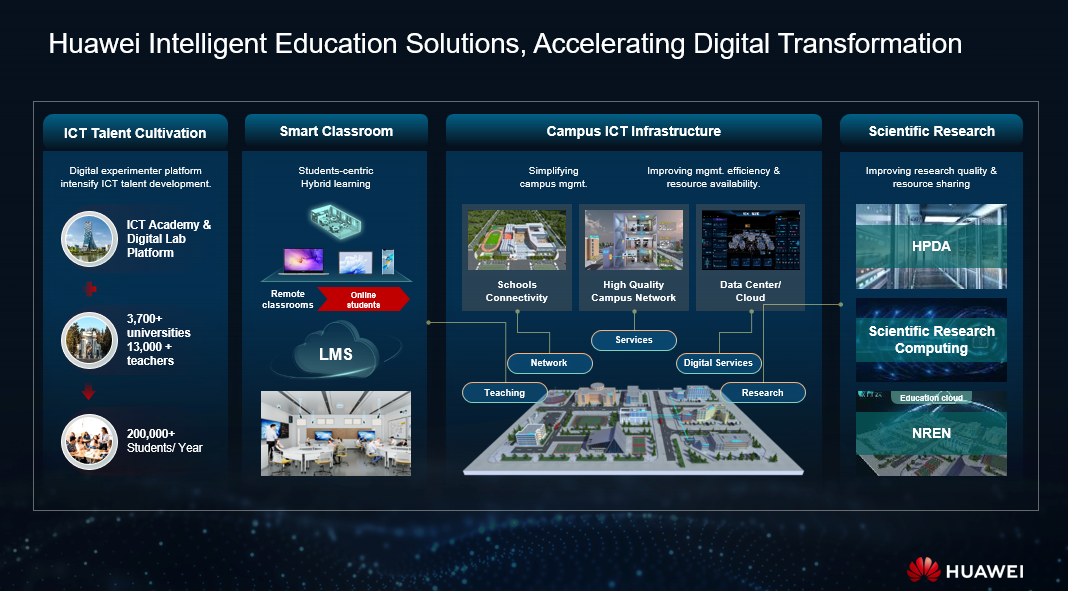
Here are our all-scenario solutions for all education customer segments.
In terms of talent cultivation, the digital training platform helps cultivate ICT talent. Each year, more than 200,000 students can be trained to master ICT technologies and engage in ICT-related work.
In the smart classroom scenario, Huawei provides the smart classroom solution, which is student-centric and extends the classroom boundary. By integrating the interactive IdeaHub, HUAWEI CLOUD, and learning management systems of certified partners, Huawei provides solutions such as hybrid learning, group discussion, and recording classroom. Make future learning more attractive and free from space constraints.
In the managed service scenario, Huawei provides campus networking and high-quality 10GE campus network solutions to help customers manage campus activities more efficiently and provide better services for customers.In scientific research, we provide scientific research HPDA, scientific research computing, and education and scientific research network solutions to help teaching and research customers improve research and information sharing efficiency.
GSEPT202401. Key technology of identity recognition based on multi-modal image intelligence and large-scale application of educational scenarios
Participants:
Ruan Jipeng, Hu Guozhi, Xiao Jinsheng, Yue Xianchang, Zhang Qian, Wang Jian, Qian Huaqi
Keywords:
multi-modal image intelligence, key technology of identity recognition, mobile terminal, image standardization, large-scale application of educational scenarios
Executive Summary:
In accordance with the "Electronic Registration of Students 'Academic Qualifications in Higher Education" and relevant provisions of qualification certificate registration online by the Ministry of Education, image acquisition of college graduates is the key link to graduate and employment as soon as possible, electronic photo is the key information of qualification certificate registration online, the students are not allowed to register and query the education information online without electronic photo. When the college organize traditional offline centralized collection, some students may be unable to arrive at school on time due to business trips, work, internship and other reasons, which will lead to the lack of photos for students and unable to register and graduate, and cause great trouble to the school and students. Key technology of identity recognition based on multi-modal image intelligence, researched and developed by Beijing Kingsha Technology Co., Ltd., with mobile image acquisition, image standardization and face-to-ID card comparison verification services as a basis, the students can use their phones to take photos anytime and anywhere, and can realize photo AI automation and standardized processing through the image standardization technology, and then get a standard identification photo. Beijing Kinsha Technology Co., Ltd. uses Face-to-ID card comparison service and Face-to-Photo comparison technology to accurately match student information and help students achieve safe, efficient, convenient and quickly image collection and identity verification. Since its launch in May 2020, the technology serves approximately 800 colleges with over 4 million students every year, and completed the large-scale application of educational scenarios. It has been applied in the standard identification photo acquisition in the field of some secondary vocational education and basic education since 2024.
Project Description:
Since 2002, the Ministry of Education has begun promoting the institution of e-registration in qualification certificate among the higher educations during the process of graduation, and then the graduates were required to provide personal electronic photo, and since then the image acquisition of graduates has been required. In the traditional offline centralized queuing and collection mode, the photographers would enter the school to take photos for students, which was time-consuming and labor-intensive, moreover, there would be some special circumstances: for example, some students were unable to reach the scene due to internships or special circumstances, and some social personnel could not attend due to work, going abroad, business trips, internships, leave, or other reasons. While, the photos submitted by students themselves could not meet the management department's standards. Therefore, we decided to develop a system that could complete the taking and standardization of identification photos through the mobile, allowing students to collect photos anytime and anywhere, without the need for schools to suspend classes, adjust schedules, or arrange for special teachers to organize offline centralized collection.
After many investigations and technical breakthroughs, Kingsha Technology Company launched the mobile image acquisition service in 2020. The problem of time and space can be effectively solved by utilizing the company's mobile image capture and image standardization technology, so that students can collect their own identification photos anytime and anywhere. After taking photos, the system uses the technology of multi-modal image intelligence, automatically standardizing the students' electronic photos. It is efficient and quick.
On the other hand, with traditional camera photography methods, students are unable to confirm their photos immediately, which will lead to dissatisfaction with the photos later on, but can not modify such issues. Now, by using the mobile-end image acquisition mode, the initiative is completely handed over to the student users in the process of image acquisition. After the students take photos with the mobile phone, the photos can be automatically adjusted for color, lighting, size, and background conversion through the AI image standardization technology of Beijing Kingsha Technology Co., Ltd., and then the photos will be transformed into standard identification photos. Students can take photos an unlimited number of times until they are satisfied, which maximizes the efficiency and student satisfaction.
GSEPT202402. iFLYTEK Spark Smart Blackboard
Participants:
Jiafeng Zhou, Hongjie Guo, Xianmin Wang, Yujue Chen, Jindong Zhan, Nan Shi, Shengcai Li, Xiulian Li
Keywords:
Educational Equipment, Classroom Teaching, Smart Blackboard, iFLYTEK Spark, Reducing Burden and Increasing Efficiency
Executive Summary:
Under the backdrop of the new technological revolution, the traditional teaching tool of blackboards has been upgraded to become intelligent and digitalized, serving as a crucial instrument for enhancing classroom teaching efficiency and students' understanding of knowledge. Utilizing advanced technologies such as artificial intelligence to improve teaching efficiency and develop students' core competencies is a central task in current curriculum reforms. The "iFLYTEK Spark Smart Blackboard" was born against this backdrop. With the support of the iFlytek Spark , it represents a new trend of deep integration between information technology and educational teaching, aiming to transform the blackboard from a traditional writing tool into an "AI assistant" for teachers.
Project Description:
In traditional classroom settings, several issues often arise:
(1) Abstract knowledge explanations are "not intuitive." Concepts like the transformation of three-dimensional geometric spaces, dynamic analysis of functions, and hands-on practice with complex chemical equations—these "abstract pieces of knowledge" can hardly be understood by students at first hearing without the aid of informational tools. They are typically conveyed only through "invisible" verbal descriptions and "static" blackboard writings.
(2) Classroom interaction between teacher and students is "not engaging." In a traditional class, teachers struggle to interact frequently with students from the front of the room while standing next to the blackboard to write; conversely, when teachers step down from the podium to approach students, they find it inconvenient to control the large teaching screen.
(3) Difficulty in handling imaginative questions. Due to the diverse knowledge structures among teachers of different subjects, they often struggle to address various creative questions from students, some of which may even fall outside the teacher’s area of expertise. Unclear, one-sided, or incorrect answers can impede students' acquisition of true knowledge.
GSEPT202403. Enhancing Personalized Learning Resource Recommendation System with Interpretable Large Language Models
Participants:
Jiahui Wang, Nan Xie, Zhengxu Li, Wei Pang, Rui Zhang
Keywords:
Interpretable, Enhancement of LLM, Personalized learning, Recommendation System
Executive Summary:
Provide a summary of your project, why it is important and how it will address a specific issue/problem. This project based on microprocessor technology course, to design an interpretable Large Language Model (LLM) oriented enhanced personalized learning resource recommendation system. It realizes time-sequential presentation of learner profiles through multi-layer knowledge mapping based on knowledge-question-learning resources to accurately capture the learning status; proposes an interpretable personalized resource dynamic recommendation method to enhance the transparency and credibility; and relies on the LLM to provide enhanced real-time learning coaching to instantly solve the learning problems. The system is committed to optimizing the learning experience, achieving accurate and efficient matching of educational resources, and actively promoting both fairness and quality of education.
Project Description:
(1) Initial intention to conduct relevant research
① Responding to the development trend of national education modernization and intelligence
Since the 1970s-80s, personalization in education has emerged as a key trend in global educational reforms, the United States, Japan, Finland and other countries have launched their own personalized teaching programs. China's Education Modernization 2035 (2019) advocates leveraging modern tech for talent training innovation, fusing mass education with personalized development, and has a good degree of advancement, foresight and development.
② Meeting the personalized learning needs of new engineering talents
New Engineering emphasizes interdisciplinary integration and the cultivation of innovative abilities. The learning resource recommendation system can customize learning paths based on students' interests, abilities, styles and career planning, stimulate innovative thinking, mobilize learning initiative and help develop a flexible and diverse education model.
(2) Problems aimed at solving
①Dynamic portrayal of learner profiles
This study proposes to realize real-time dynamic update of learner profiles through continuous tracking of learners' learning behaviors, changes in interests and feedback on effectiveness, in order to accurately grasp the personalized needs of each learner. ②Interpretable Personalized Learning Resource Recommendation
This research proposes to develop a personalized learning resource recommendation system with interpretability to promote the improvement of learning experience and efficiency.
③LLM-enhanced learning process coaching. This study proposes to explore intelligent and personalized learning path planning and real-time coaching solutions by using LLM technology to enhance the interactivity and effectiveness of the learning process.
Beijing Normal University (BNU)
Smart Learning Institute of Beijing Normal University (SLIBNU)
National Engineering Research Centre of Cyberlearning and Intelligent Technology
TEL:010-58807303
EMAIL:gse@bnu.edu.cn
© 2025 All Rights Reserved.